वेदार्थ पारिजात - १ स्वामी करपात्री — पृष्ठ 21–30
वेदार्थ पारिजात - १ स्वामी करपात्री · पृष्ठ 21–30
पृष्ठ 21
पाठ पढ़ें पाठ छिपाएँ
? 9 ) provedic smrtis, purIIas, itihIsa and darIana, what will be the difference between India and the other countries? Every man born in India must bear this in mind. The Vedas are the life breath of Mother India, without which she will merely be like a corpse. Granted there may be scientists capable of providing India with atomic weapons capable of destroying the entire world instantly, and manufacturing supersonic rockets, but all this will not make a special feature for India since other nations may have greater scientists to beat all our inventions and material discoveries. There is a threefold division in human knowledge, namely worldly knowledge, science and transcendent wisdom. Our ancients, considering that knowledge and science are ever evolving and changing but this alone is changeless, they strove hard towards this unsurpassable transcendent wisdom. Even after a man obtains the things obtained by everchanging material knowledge and science, they will be of little use to him. They will not contribute to his peace of mind. The result would be that men would become constantly greedy for obtaining more and more through material knowledge and science. In accordance with the saying " Realizing oneself through yoga is the highest Dharma ( duty ) " the ancient sages determined that the self - realization is within the orbit of Dharma and thus decided that Dharma is of still greater importance even than mokIa ( salvation ) and thus have regularly strived to preserve the Veda as its original source. Preservation of the Vedas means Vedic recitation and teaching of the Vedic recita. tion since the Vedas have been preserved only by means of a systematic teaching of the recitation. Indeed the Veda is nothing but a specific phonetic collection that can be acquired through a particular mode of phonetic utterance of a disciple exactly imitating the phonetic recitation by the preceptor. This unbroken chain of teaching and learning from preceptor to disciple is known as sampradaya. The acquisition of the Vedic knowledge has ever been possible only through this systematic teaching series on these Sampradayic lines. According to Mimämsä theory the actions have been classified four fold as follows viz - 1. Creation, 2. Acquisition 3. Variation and 4. Modification. The learning of the Vedas and provedic Iästras falls within the orbit of ' Apti ' ( acquisition ) that brings about a sort of specific mode of mental modification within the disciple. There are definite set rules and regulations for the study of the Vedas that cannot be obtained simply through a mere look into the books. A systematic recitation of one's own Vedic branch according to the Sastric commands is ever imbued with definite unfailing results. The daily recitation called svädhyaya is a tapas. Tapas ( penance ) gives rise to the power of control and benevolence. We have seen the children, young men and even grown up people being cured of various maladies simply through the sacred ashes ( bhasma ) given by a regular reciter of the Vedas. In the old times when physicians were not available in the villages or even in big cities, it was these pious vedic hermits that came to the rescue of the afflicted. Just as there are set rules for acquisition of the vocal composition of the Veda, also is there an established tradition for their interpretation. This tradition is not an outcome
पृष्ठ 22
पाठ पढ़ें पाठ छिपाएँ
( I ) simply of blind faith. PürvamimImsI, Vedanta sütras, and Nirukta of YIska have laid down definite rules on scientific lines for interpretation of the Vedic texts. Just like a well fortified approach to the palace of a great king, our sages have also developed sound and steady fortifications in the form of SikII ( phonetics ) and VyakaraIa ( grammar ) to get at the real hidden sense of the Vedic terminology. Besides these two protective barriers, one has still to cross the fortification in the form of a sea of rules, laid down in the Mimämsä, the fortification which is the ocean of logical argumentations by the Naiyayika Logician Lions, the ocean of paurIIic texts and dense jungles of Dharmasastra. It is then and then alone that one can become competent to get at the meaning of Veda. Thus Yajnavalkya - smIti counts as many as fourteen forms of knowledge and of Dharma viz PurIIa, Nyaya, Mimämsä, Dharmasastra, the six Vedic ancillary disciplines and the fourfold Veda itself count as the fourteen forms of knowledge, essential to indicate the real meaning of the Veda. Enemies intent on killing the king somehow try to enter the palace inspite of the impregnable fortifications. Just so antivedic enemies like Buddhists intent on uprooting Veda altogether, since they do not accept the authority of Veda, have repeatedly sought to attack the Vedic Dharma. The Gods are generally confronted by the Demons. The battle of Gods and Demons is quite old. The presence of obstacles and hindrances is only a road to a discrimination between right and wrong. For a Judge to pronounce his decision it is essential that both the parties, the complainant and the defending one, must be present with their respective statements. Thus, seeing that the agnostics were attacking the VedapuruIa, Kärttikeya and Iiva descended on earth as Kumärila and AdiIankarIcIrya. The Buddhists had started uprooting the Veda and provedic Iâstras, the original sources of Dharma. Then KumIrila and SankarIcIrya rescued them from their onslaughts. These were followed by Provedic Scholars like UdayanIcIrya, VacaspatimiIra AppayadikIita and the like. Each of these philosophers inspite of their different philosophic outlook never swerved from the authority of the Veda. Thus once again there started a current for the study of the Vedas and their real meaning. They moved along the Vedic path steadily in order to reach their destination. Just as a pilgrim has to remove thorns and barriers, so also these great philosophers disproved the illicit arguments of their opponents. Such opposition need not be always external but sometimes even provedic philosophers may also differ in philosophic viewpoint. There is thus also a tradition of support for refutation amongst the provedic scholars themselves. And yet the other school of thought is not rejected as altogether unnecessary. Inspite of their mutual differences they are ever united against the anti - vedic agnostics just as Kauravas and PIIIavas, inspite of internal differences were united against external enemies. This has been a rule of conduct amongst the ancient philosophers of India. There has been a perpetual struggle amongst the provedic and anti - vedic schools. In recent times in India, a new doctrine has crept up and is causing terri-
पृष्ठ 23
पाठ पढ़ें पाठ छिपाएँ
( १ ९ ) ble anxiety. The anti - vedic agnostics were out to uproot the Veda altogether. But As the new doctrine accepts one part of the Veda and rejects the other. if a person were to cook half of a hen for meals and leave the other half to lay eggs. This is like outraging the chastity of the old Veda mother by pulling her hair with one hand and cutting them off with the other. The old Veda mother, shattered as if by old age is helpless in their hands. We used to hear the story of pulling of Draupadi's hair but today we actually see the outrageous treatment meted out to Veda mother herself. Not only this, but these people are not ashamed of decrying Mimamsã that tries to follow up and protect Veda - mother like a loyal daughter of the Vedas. They produced a vast vedänga literature to counteract the crocodile like antivedic arguments in the limitless Vedic ocean and to ward off the antivedic lions from the impenetrable vedic jungle and thus they arrive at unflinching decisions. The ancient Indian Sages produced a vast intellectual and practical literature in defence of the Vedas. It gives deliberations apprehending the dwindling of the study and teaching tradition of the Vedas. The sages composed smrtis and treatises through the summary of various branches of the Vedas. Even in the presence of Nigama, Nirukta and VyakaraIa for Vedic textual interpretation, the Mimämsä set forth a number of maxims for determining the textual meaning of the Vedas. All provedic philosophers bear a respectful regard for these maxims and fundamental rules of Minämsä. A due study of and loyalty to these rules is regarded as a prerequisite for the correct interpretation of the Vedic Text. It is a contention of certain modern writers that four Samhitas alone constitute the Veda and that the BrIhmaII portion is not Veda and that the ancient sages composed new mantras, added them to the Samhitas and devised new directive viniyogas, fresh ritual wherein they would be used. In the beginning, in general, rituals of pious and non - violent nature like Agnihotra, DarIapIrIamIsa and Câturmäsya were provided. But later on were superadded the dark rituals that were performed with great pomp and were intended to bring more and more wealth for the officiating priests. Certain modern writers contend all this quite shamelessly. They do not stick to any firm standpoint and go on blurting quite brazenfaced and without the least hitch that the Brahmana portion is not Veda. And still they also quote the same BrähmaIa portion as an authority as and when it suits their ends. And nevertheless they reject the other portion as unauthoratative. They condemn any text as an interpolation if and when it conflicts with their views. They further contend that the hymns in the Samhita portion are also indicative of their procedure and that no text on the BrahmaIa portion is required for direction of their use. They also hold that the mantras need not be connected with rituals. They also regard Vedas dealing
पृष्ठ 24
पाठ पढ़ें पाठ छिपाएँ
( २० ) with worldly and social matters and persuading and guiding people in various worldly affairs. A thief enters a house like a sneaking cat but these people openly enter the vedic citadel in broad daylight and pull the hair of Mother Veda in the presence of onlookers. The Mimasa that is intended to determine the real aim of Dharma is merely a trifle for them. Savants like Jaimini, Iabarasvami and great Kumärila are quite insignificant for them. They are quite blind to the context and interconnections of sentences in the entire mass of Vedic Literature. Viewing this sad state of affairs, the compassionate personality of Iri KarapItrI. svami convened repeated seminars of great scholars for and against this traditional doctrines, brought them into the arena of debate and himself participated in discussions. It is my personal experience that these people apprehending a defeat in the discussions take to pelting stones and creating rowdyism. Stone throwing is quite an ordinary thing for those who can pull the Vedic mother's hair. When failing to prove one's argument by logical reasoning or the textual authority, their only face saving device is stone throwing. They dispute regarding the Vedic GODs and pronounce high sounding statements on the Supreme GOD. The meaning of the text is only subjected to their whim. After a thorough study of VedabhIIya and RgvedabhIIyabhümikä by Svâmi Dayananda and books written by his followers like Brahmadatta JijñIsu, Bhagavat Datta and the like and finding no other path to save the Vedas from these unbehoving onslaughts, Iri KarapItrisvImi, after reviewing this serious situation, has composed a commentary on the Vedas called VedIrthapärijäta basing his arguments on the books written by ancient provedic philosophers. Not only a commentary but he has also written an extensive introduction containing a critical review of all these matters. The present volume is the first part of the introduction. The second is expected to follow shortly. In this volume the sources of knowledge are examined in the beginning in accordance with a maxim that the proof of a correct knowledge is dependent on the authority of its source. In this connection, Svämiji has also examined the Buddhists view of the sources of knowledge. There is a serious dispute between the provedic and antivedic philosophic schools, regarding the authority of Word as a source of knowledge. Svamiji has discussed this point at length quite impartially. There is a great dispute amongst the philosophies regarding the authority of the sources of knowledge. This discussion is known as PramIIa theory, Pramanyavada. In this connection he discusses at length the meaning and nature of the Veda, their non - individualistic or non personal composition and their validity as source of knowledge. Then follows an examination of the views of Svami Dayananda. It is proved in a very interesting manner how the Brähmapa portion, inspite of its elucidation of the meaning of hymns in the Samphitä portion, still remains of nonpersonal origin. This is proved to the hilt with strong arguments. What is the process
पृष्ठ 25
पाठ पढ़ें पाठ छिपाएँ
( २१ ) for determining the nature and meaning of a word and the nature and meaning of a sentence and what is the authority in determining the meaning forms a very interesting discussion. The views of Svami Dayananda in these matters and their solution, again, how the Svämi's followers argue in this regard and what exact is a reply to their objections - there is an ample light thrown on such matters. In this context the views of aphorism ( sItra ) philosophers, the smrti sages and the treatise writers have also been discussed at some length. In the course of the discussion, the learned author has introduced many other topics, e. g., what do verb roots like hisi and alabhati exactly mean? what exactly is a procedure for their use? what exactly is a scope of the injuction ‘ he shall not kill ( na himsyät ) '? Such matters are also given a fitting treatment. To this end the nature and scope of general rules and exceptions and the respective stands of Mimämsä and Vedanta are also explained. The erroneous view of the modern Ärya SamIjists regarding the nature of the GODs have been dispelled through strong arguments, authoritative testimonies and other sound reasons. What possibly should be the purpose behind undertaking such as arduous task in such as old age? Surely it is nothing but the service of the Universe as a whole. In absence of such an effort only a distorted figure of the universal Sanatanadharma and its basic authoritative sources. The Vedas, as presented today by the Arya Samajists and other modern scholars would come to be regarded as the real and the only truth. Even though no one can fully conceal the truth yet at times men can be deluded into falsity through erroneous conceptions. This work of SvImI KarapItri Ji MahIrIj is really effective in preventing this mischief. No person is expected to be interested in Dharma in this machine age but we cannot say with certainity that the times will never change. As the wheel of time is ever revolving, a time may come to usher in a beautiful consonance of the Universal ancient Dharma and culture. A tendency to commit fraud on the Vedic and provedic ŠIstras as also on the public in general by the Arya Samajists and certain other modern writers is really painful to scholars. These people try to throw dust in the eyes in broad daylight. How else could they impute composition of fresh Mantras by Rsis in the face of authoratative work like KalpasItras of great sages like KItyIyana, Ipastamba, AIvaläyana and others and their application in new ritual performances? They cannot hide away the vast Vedic literature any more than a thief can conceal a pumpkin in his clothes. They allege that the Taittiriyasamhita is not the original Veda and that it is of a later composition. We know on the authority of the Ramayana of Valmiki, the first poet of the world, that Kathaka and Taittiriyasamhitä were being regularly recited in those times. Are we to accept Apastamba as a liar and on the other hand regard Brahmadatta and his companions as apostles of truth? It would be quite
पृष्ठ 26
पाठ पढ़ें पाठ छिपाएँ
( २२ ) surprising if those who do not know even the secret of Acamana ( the ritual sip of water ) an initial requisite of all karmakanda were to be tellers of truth regarding karmakIIIa at present. There is no other Iakha of Veda so well recited concerning and protected as the TaittiriyaIIkhI of the Yajurveda. We can clearly see that in this twentieth century the traditional recitation of the Veda is practically disappearing. This recitation and study is that of one's own recension and not of entire Veda for there is a commandment " Study and recite one's own Vedic recension ”. In ritual performance, one needs one's own recension of one's own Veda, not another recension even of the same Veda. Granted, there may be a necessity for knowing the text of other recensions of the same or the other Vedas, but there is a rule that " one should recite a recension of another Veda only after one has recited one's own recension ". And those who know nothing of their own ritual sItras, gotra or pravara, cannot but blurt out that only the four Samhitas constitute the Vedas. Yet the Veda accepters, when offering salutation recall their own sItra, gotra and pravara. For example, O Revered Sir: I, IrI KIIIa IarmI sprung of Bhargava, CyIvana Apnavana Aurva Jamadagnya pancarIeyapravara, belonging to the Srivatsagotra, ApastambasItra, reciter of TattiriyaIIkhI of the Yajurveda, salute you. " Similarly the BaudhIyanasutra Sâmavedi, BhIradvIja and DrähyIyaIa sütra reciter of Kauthuma Sakha of the Samaveda and reciter of the SakalaIIkhâ of the Igveda would offer their respective salutations in their respective ways. They all have to recall their own respective recension obtained through their traditional recitation. If only four samhitas were to constitue the Veda, why do they remember all this in the salutation? Furthermore, the Vaidikas have regularly to strive to protect the sentences, clauses, words, consonants and vowels, their deities, the vocal organ, place of articulation, the limit of time and tune of articulation and so on in their own respective Vedic recensions, taking for instance, the word AgniI ( fire ). Teachers of Vedic recitation protect this word before recitation in the five kramas viz 1. IuddhavarIakrama 2. svaravarIakraina 3. mäträvarIakrama 4. angavarIakrama 5. varIasarakrama. 1. SuddhavarIakrama consists of A; two G's; the third yama of G; N; I; visarjaniya. 2. In the SvaravarIakrama the non - raised A; two G's; the yama of G; N; raised I; and visarjaniya constitute the whole word. 3. MItrIvarIakrama again consists of A of one matrI; -mätrI stopping of phonation; two 4 - mâtrâ G's; the yama 1 - mItrI; -mätra N; one - mäträ raised I; 4 - mItrI stopping of phonation; -mItrI visarjaniya; 2 - matra stopping of phonation. 4. Angavarnakrama. One - mItrI non - raised A; -mäträ stopping of phonation two 4 - matra G's, as constituent of the preceding A; 7 - mäträ yama of G as a constituent of the preceding A; mätra N as constituent of the following I; one matrI raised I; -mItrI
पृष्ठ 27
पाठ पढ़ें पाठ छिपाएँ
( २३ } of stopping of phonation. -mItrI Visarjaniya as constituent of the preceding I; 2 - matra of stopping of phonation. 5. VIrIasärakrama. One - mItrI A. It is pronounced with phonetic effort called vowel closure produced by contracted vocal cords. The place of articulation is the lower jaw, not completely closed. The lips as the articulators are also not completely closed. The articulatory effort is called closure. It has a non - raised, tone of the variety called short non - raised whose deity is Agni, caste is Ksatriya and quality is darkness. This tone is signalled by placing the tip of the thumb at the first line of the smallest finger. It springs up in the heart and is cause of the musical tone RIabha. It is like the soft bellowing of a bull emanating from the throat cavity; strengthened by a shortness of the body. The deity of A is Väyu and its caste is BrähmaIa. -matra stopping phonation. 2. 1 - mäträ G's, constituents of the preceding A. These are voiced sounds with phonetic effort produced by contracted vocal cords and called consonantal closure with minimised breath. The place of articulation is the posterior portion of the lower jaw. The posterior portion of the tongue is the articulator. The articulatory effort is called stoppedness. Their deity is Bhumi and their caste is KIatriya, 1 - mäträ yama of G, constituent of the preceding A. It is voiced sound with phonetic effort produced by contracted vocal cords and called consonantal contraction with minimum breath. The nasal resonator is closed. The place of articulation is the posterior portion of the lower jaw. The posterior portion of the tongue is the articulator. The articulatory effort is called stoppedness. -mäträ N, constituent of the following I. This is a voiced sound with phonetic effort produced by contracted vocal cords and called consonantal closure with minimum breath. The nasal resonator is open. The place of articulation is the root and lower part of the upper jaw. The articulator is the tip of the tongue. The articulatory effort is stoppedness. Its deity is Sürya and its caste is Vaisya. One - mätrI I. It is a voiced sound with phonetic effort called vowel closure produced by closed vocal cords. The place of articulation is the hard palate. The articulators are the middle of the tongue and the nearly completely contracted lips. The articulatory effort is called openness It has a raised tone, whose deity is Bhumi, caste Brahmana and quality luminosity. This tone is signalled by placing the tip of the thumb at the middle line of the index finger. It is produced in the head and is cause of the musical tone Gandhara. It is like the shrill bleating of a she - goat emanating from the throat cavity, mellowed by length of body. I's deity is Agni and its caste is BrahmaIa. -mäträ stopping of phonation.
पृष्ठ 28
पाठ पढ़ें पाठ छिपाएँ
( २४ ) -matra visarjaniya constituent of the preceding I. It is a voiceless sound with phonetic effort called breathy consonantal voicelessness. The place of articulation is the upper part of the vocal cords. The articulator is the lower part of the vocal cords. The articulatory effort is called openness. Its deity is Surya and its caste is Iûdra. 2 - mätra stopping of phonation. This, for instance, is a demonstration of the amount of effort in protecting one word Agni. In the same way the traditional vaidik scholars protect every word of the Veda. All the rules and regulations of this procedure are separately described in the VyIsasikII I have edited. Even today certain traditional vaidika scholars who protect the Veda in this way are still living. To the utter disregard of all these efforts, certain modern propogandists blurt out that TaittiriyaIâkhI is not Veda, Sri KarapItrisvImI MahIrIja has given in extenso fitting reply to all these allegations, together with quite sound arguments. They are to be found in their proper context in the present book. All other aspersions and objections regarding the Veda are appropriately answered and should be studied with attention in their proper place. I am confident that this book will be of great value to the research scholars. A translation of the book in Hindi has been provided and published for the benefit of those who do not know Sanskrit. This volume is only the first part of the introduction. In its second part, an English summary of the introduction will also be presented so that foreign scholars desireous of knowing the subject matter of the book, may be able to benefit thereby. We thank Pt. IrI Markandeya Shastri, Pt. Sri Brij Vallabh Dvivedi and Sri Musalgaonkar Shastri for their invaluable assistance in locating the sources of quotations in the original texts, for preparing the press copy, for correcting the proof sheets and for the Hindi translation thereof. I firmly believe that all these scholars amply deserve the worthy blessings of IrI SvImi Ji MahIrIja. I conclude with a prayer that by the grace of Lord ViIvanätha the second part of this introduction and the commentary on the Veda itself which we intend to publish will soon be completed without any hindrances. Translation: Elliot M. Stern, Research Fellow, Varanasi Pattabhiram Shastri
पृष्ठ 29
पाठ पढ़ें पाठ छिपाएँ
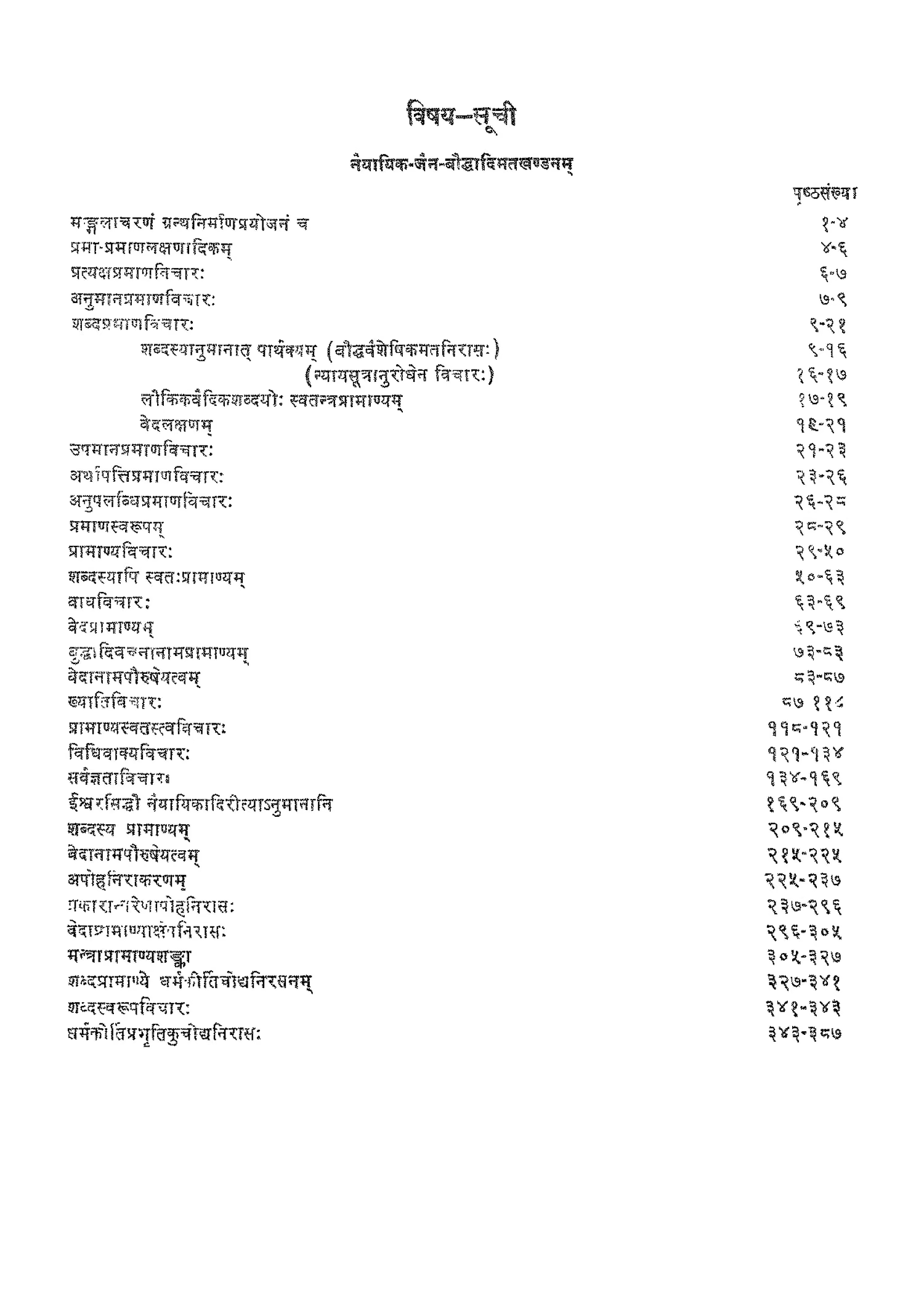
मङ्गलाचरणं ग्रन्थनिर्माणप्रयोजनं च प्रमाप्रमाणलक्षणादिकस् प्रत्यक्षप्रमाणविचारः अनुमानप्रमाणविचारः शब्दप्रमाणविचारः विषय - सूची नैयायिक जैन - बौद्धादिमतखण्डनम् शब्दस्यानुमानात् पार्थक्यम् ( बौद्धवैशेषिकमतनिरासः ) ( न्यायसूत्रानुरोधेन विचारः ) लौकिकवैदिकशब्दयोः स्वतन्त्रप्रामाण्यम् वेदलक्षणम् उपमानप्रमाणविचारः अर्थापत्तिप्रमाणविचारः अनुपलब्धिप्रमाणविचार: प्रमाणस्वरूपम् प्रामाण्यविचारः शब्दस्यापि स्वतःप्रामाण्यम् वाचविचार: वेदप्रामाण्यम् बुद्धादिवचनानामप्रामाण्यम् वेदानामपौरुषेयत्वम् ख्यातिविचारा प्रामाण्यस्वतस्त्वविचारः विधिवाक्यविचारः सर्वज्ञताविचार ईश्वरसिद्धी नैयायिकादिरीत्याऽनुमानानि शब्दस्य प्रामाण्यम् वेदानामपौरुषेयत्वम् अपोनिराकरणम् प्रकारान्तरेणापोहनिरास: वेदाप्रामाण्णाक्षेोनिरासः मन्त्राप्रामाण्यशङ्का शब्दप्रामाण्ये धर्मकीर्ति चोधनिरसनम् शव्दस्वरूपविचारा धर्मको विप्रगृतिकुचोद्य निरासः
पृष्ठ 30
पाठ पढ़ें पाठ छिपाएँ
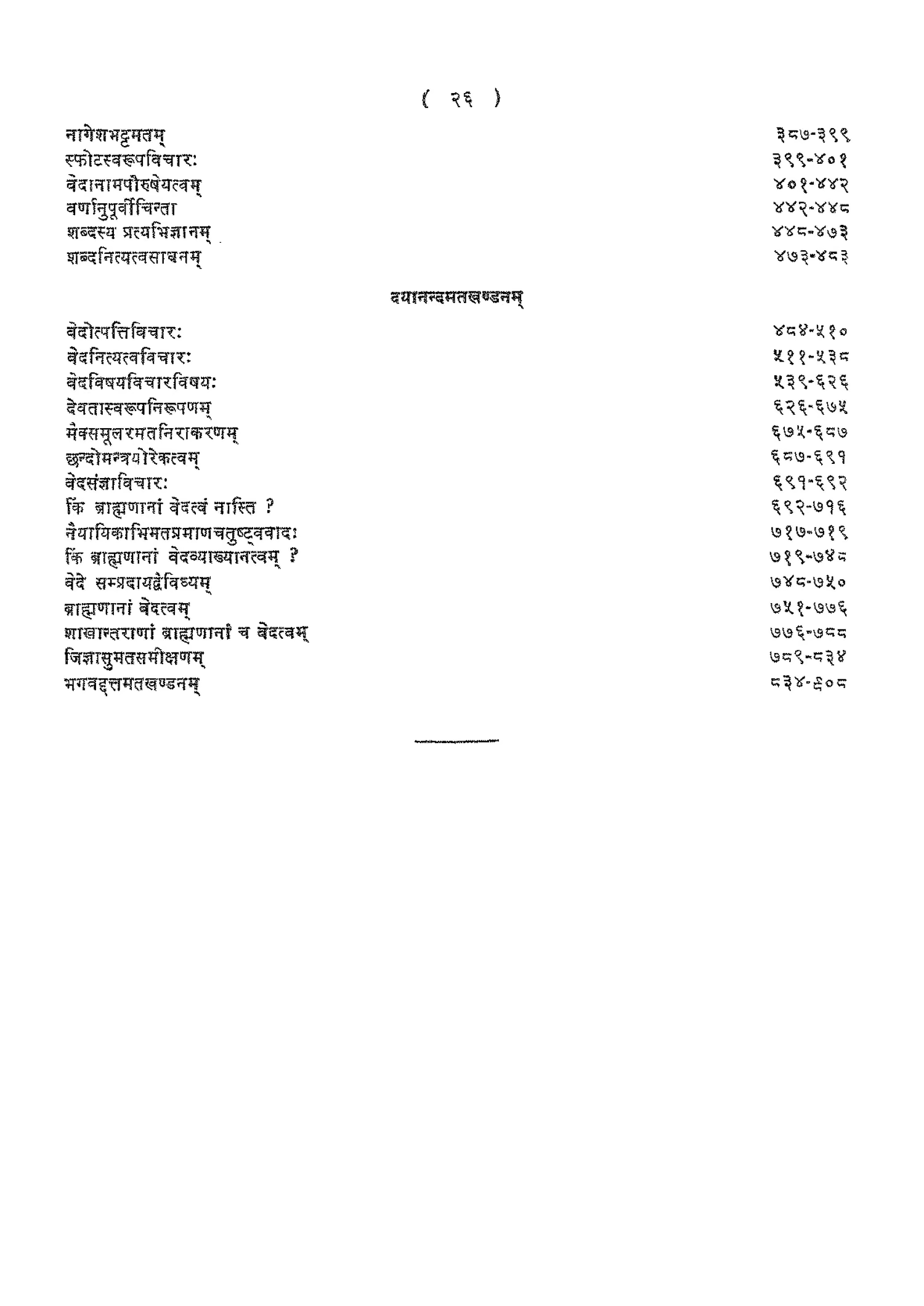
नागेश भट्टमतम् स्फोटस्वरूपविचारः वेदानामपौरुषेयत्वम् शब्दस्य प्रत्यभिज्ञानम् शब्दनित्यत्वसाधनम् वेदोत्पत्तिविचारः वेदनित्यत्वविचारः वेदविषयविचारविषय: देवतास्वरूपनिरूपणम् मैक्समूलरमतनिराकरणम् छन्दोमन्त्रयेोरेकत्वम् वेदसंज्ञाविचार: किं ब्राह्मणानां वेदत्वं नास्ति? नैयायिकाभिमतप्रमाणचतुष्ट्ववादः किं ब्राह्मणानां वेदव्याख्यानत्वम्? वेदे सम्प्रदायद्वैविध्यम् ब्राह्मणानां वेदत्वम् शाखान्तराणां ब्राह्मणानां च वेदत्वम् जिज्ञासुमतसमीक्षणम् भगवद्दत्तमतखण्डनम् ( २६ ) व्यानन्दमतखण्डनम्